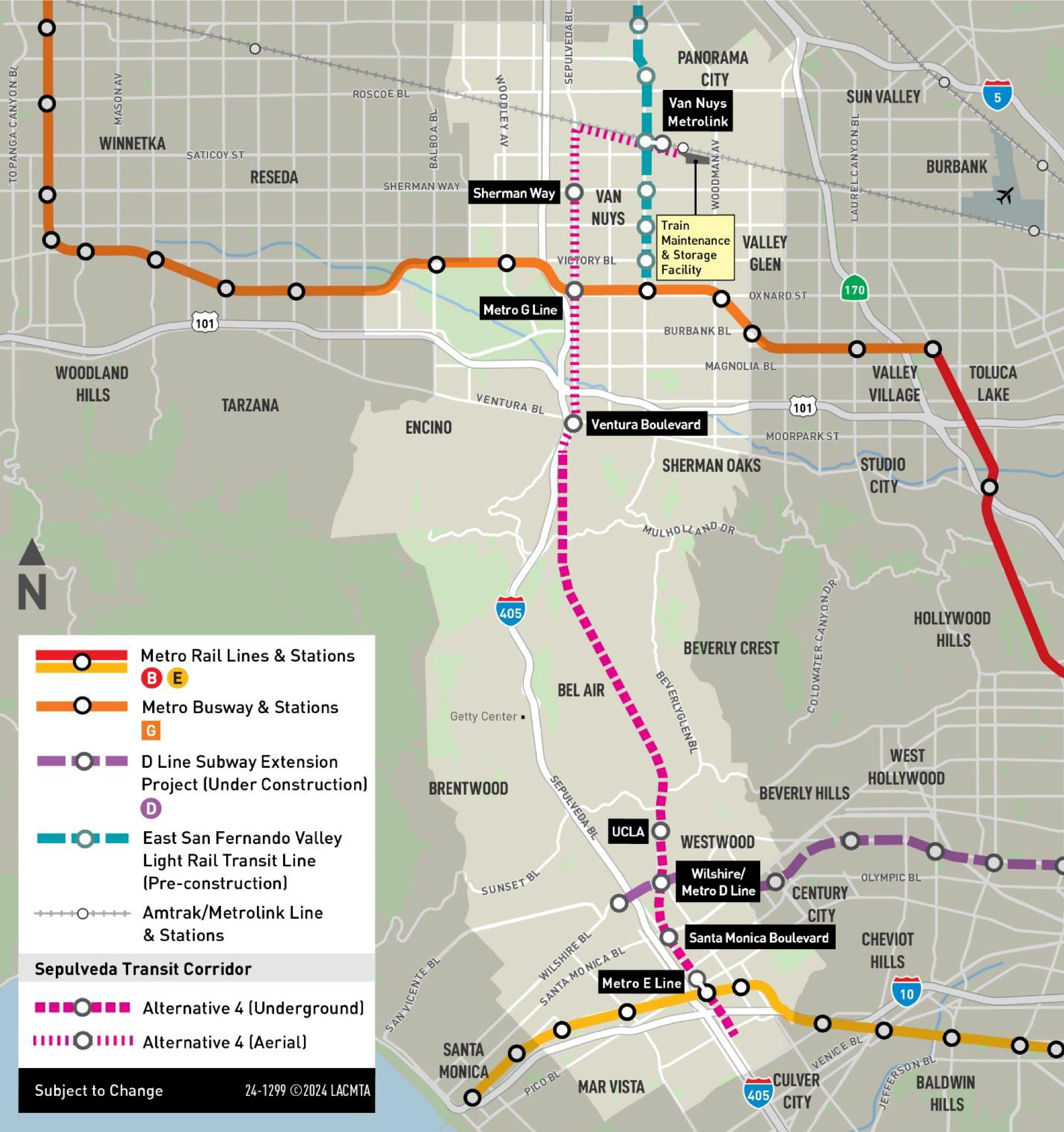
The LA County Metropolitan Transportation Authority is considering five options for its Sepulveda public transit system that would stretch from Van Nuys to West Los Angeles, four of which would require tunneling under Bel Air.
Metro will soon release the project’s draft environmental impact report, which will provide greater insight into any possible disruptions caused by tunneling deep underground for a subway, or from building an aerial monorail along the 405.
“The cost to build the project is estimated to be between $15.4 billion and $24.4 billion, while yearly operations and maintenance of the system would cost between $130 million and $157 million,” said Metro in a May 23 statement. “Cost projections are preliminary, as the project is only at 15% of design and will continue to be refined as it advances through the development process.”
Metro says the project could reduce commute times for riders by up to 50% during rush hour.
Should funding and review go smoothly, the line would begin operations between 2033 and 2035, with up to 124,000 daily boardings.
Public input sessions on route options were scheduled to be held early in April, but were delayed to the end of May, likely in conjunction with a delay in finalizing the draft EIR Metro says will be released soon.
The project’s objective is to connect Metro’s fairly developed, or soon-to-completed Valley and Westside rail systems to relieve worsening traffic and congestion.
Alternative 1, the lone non-tunneling option after the removal of Alternative 2, is the option least opposed by Bel Air resident Fred Rosen, who has been a vocal critic of and led opposition against the project. This automated monorail would carry passengers along Sepulveda above-ground, stopping at Metro’s light rail line under construction in the Valley, Ventura Boulevard, the Getty Center, the Metro D Line stop under construction at the West LA VA, Santa Monica Boulevard, and the Metro E line in 28 minutes.
This option is opposed by UCLA, as it would require students and staff to take an electric bus to campus on highly congested Wilshire Boulevard.
It could also result in greater 405 traffic during construction, and would run at two-thirds the speed of and have just over half the capacity of the solely underground options, which could become an issue if the county reverses its population decline and starts to grow again and more capacity is needed later in the century.
Alternative 3 would run above-ground until the Getty Center, at which point it would move underground, tunneling under Bel Air to the UCLA campus, then to the D Line station at Wilshire and Veteran, also with an automated monorail — and take 32 minutes.
Alternatives 4 would not stop at the Getty Center, 5, and 6 would not stop at the Getty Center, and would be wholly underground in Bel Air.
Alternative 4, which would take 20 minutes, would include an aerial section until passing its Ventura Boulevard stop, meaning that while it is the most affordable of the three options, it would create the most traffic during its construction.
Alternative 5 would take 19 minutes and be almost entirely underground, except for a brief portion between its Van Nuys Metrolink and Sherman Way stops.
While Alternatives 4 and 5 would be automated, keeping running costs lower and making it easier to add trains, Alternative 6 would have a driver, and is the only option that would go west of the 405.
Alternative 6 — the fastest route, clocking in at 18 minutes — would largely follow Beverly Glen, thus avoiding most of Bel Air, while Alternatives 4 and 5 go right under the center of the neighborhood.
Alternative 6 is the only option in which the line would end west of the 405 at the E Line’s Bundy, not Sepulveda station, which is in a less dense area with fewer transit connection options.
Alternative 1 and 3’s monorail plans are being developed by a consortium that includes Chinese infrastructure giant BYD.
Meanwhile, the automated rail plans for Alternatives 4 and 5 are being developed by a consortium led by Bechtel, an American firm that built the Hoover Dam and the Bay Area Rapid Transit system.
Alternative 6 is being explored by LA Metro itself, and could be least disruptive to Bel Air residents.
60 days after the draft EIR is released, LA Metro’s board will vote to decide the final option after a period of public comment.
While future funding is likely to remain available via existing funding such as Measure M, a half-percent countywide generating over $1 billion per year for transit, other funding via state and federal grants may be more tenuous.
With the state-funded Legislative Analyst’s Office projecting annual deficits in the tens of billions of dollars for the indefinite future, and the Trump administration suspending further California high speed rail funding grants, these sources may be limited for years to come.
Further complicating matters is Metro’s slow return to pre-pandemic ridership despite increases in train frequency, addition of late-night trains, and new train infrastructure. In its latest February update, Metro shared weekday boardings are at just 80.7% of pre-pandemic levels, with weekend ridership at 93.1%.
This suggests that while leisure riders seeking to save en route to activities may be willing to replace car trips with train and/or bus rides, the transition to hybrid and remote work, paired with a downturn in private sector employment in the state is holding back weekday transit use.
While the Metro’s top A Line, which takes riders between East LA to Downtown, carries 70,000 passengers per day on weekdays, the E Line, which takes riders between Santa Monica and East LA, carries just 52,000 passengers on weekdays.
At a cost of at least $15.4 billion, assuming the train carries as many riders as the A Line each day and collects a fare of $1.75 per passenger, the train would eventually pay for itself after 344 years, demonstrating the system is almost entirely dependent on external financing via taxes, bonds, and state and federal grants for construction.